
 EN
EN
So, you're working with a Ti6Al4V titanium component—maybe it's a marine propeller shaft, an aerospace bracket, or a medical implant. You already know why you chose it: it's incredibly strong, lightweight, corrosion-resistant, and biocompatible. You've sourced high-quality material, whether as premium powder for additive manufacturing or as a finished precision part. Now you're ready to apply a protective coating to ensure it performs flawlessly in service. But here's the reality check: the single most important factor determining whether that coating succeeds or fails often happens before any coating is sprayed, dipped, or deposited. It's all about surface preparation.
Skipping or rushing through surface prep is the most common and costly mistake in working with titanium. A poorly prepared surface will cause even the most advanced, expensive coating to peel, blister, or delaminate prematurely, leading to rapid corrosion, wear, or catastrophic part failure. This is especially critical for ti6al4v titanium because its greatest asset—a naturally forming, ultra-stable oxide layer that grants superb corrosion resistance—is also its biggest adhesion challenge. This guide will walk you through a professional, proven approach to preparing Ti6Al4V surfaces, transforming them from a coating's worst enemy into its strongest ally.
Understanding the Core Challenge: The Dual Nature of the Ti6Al4V Surface
Why is coating Ti6Al4V uniquely tricky? The answer lies in a paradox. The alloy's renowned corrosion resistance comes from a thin, tenacious, and self-repairing oxide layer (primarily TiO₂) that forms instantly upon exposure to air. This passive layer is chemically inert and incredibly adherent to the base metal—great for longevity, but terrible for providing a "grippy" surface for a new coating to bond to. It offers almost no mechanical "tooth" for adhesion.
Furthermore, titanium is highly reactive. During manufacturing processes like machining, forging, or heat treatment, the surface can easily become contaminated with cutting fluids, lubricants, oils, or even embedded particles from tooling. If heated in air, a brittle, oxygen-enriched surface layer called "alpha case" can form, severely compromising the underlying metal's properties. Any of these contaminants create a weak boundary layer between the pristine substrate and your new coating. Therefore, the mission of surface preparation is twofold: First, to completely strip away this contaminated, weak top layer. Second, to actively engineer a new surface that is clean, active, and optimally receptive to bonding—both mechanically and chemically.
The Non-Negotiable Foundation – Degreasing and Deep Cleaning
Every successful coating process is built on immaculate cleanliness. This initial step is dedicated to removing all organic contaminants that mechanical methods can't touch. The best practice begins with an industrial-grade alkaline or solvent-based cleaner in an ultrasonic tank. The ultrasonic cavitation provides microscopic scrubbing action that dislodges contaminants from pores and micro-cracks invisible to the eye.
This must be followed by multiple thorough rinses in deionized or reverse osmosis water to remove any cleaner residue, which itself can become a contaminant if left behind. The final verification is the "Water Break Free" test. After the final rinse, observe how clean water sheets off the part. On a perfectly clean surface, water will form a continuous, unbroken film. If it beads up or breaks into droplets, hydrophobic contaminants like oils are still present, and the entire cleaning process must be repeated. There is no shortcut here.
Building Mechanical Grip – The Science of Abrasive Blasting
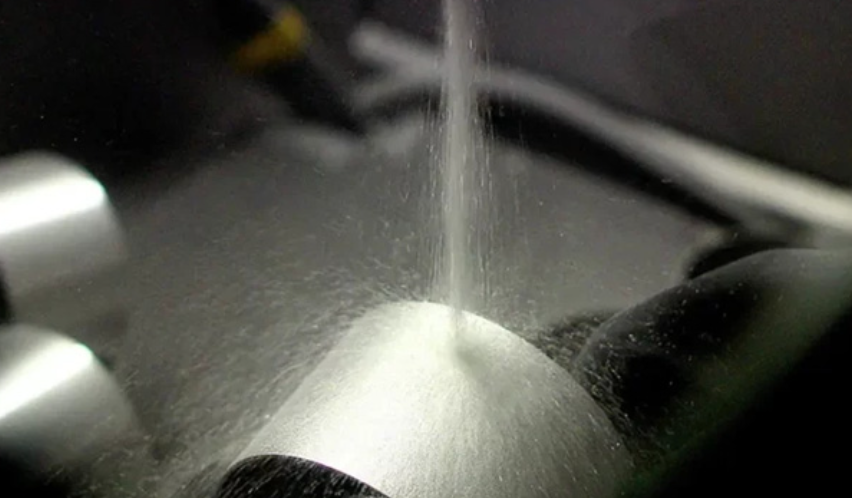
Abrasive blasting is the workhorse for creating the surface profile essential for mechanical adhesion, also known as mechanical interlock. It accomplishes the dual task of cleaning and roughening in one step. The choice of abrasive media is absolutely critical for Ti6Al4V. Angular aluminum oxide (alumina) is the industry-preferred choice due to its hardness, sharpness, and cleanliness. It is vital to avoid silica sand, which can embed in the soft titanium and cause future failure, and steel grit, which risks iron contamination leading to galvanic corrosion spots.
The process parameters dictate the final result. Precise control over air pressure, blast angle, distance, and time is essential to achieve a uniform, anchor-shaped profile. For most coating systems, a surface roughness average (Ra) between 3 to 6 micrometers provides the ideal "tooth" without causing excessive cold work. Immediately after blasting, the part must be cleaned with dry, oil-free compressed air to remove embedded media dust. Time is of the essence, as the freshly blasted, high-energy surface will begin to re-oxidize rapidly. The best practice is to move the part directly to the next step within a few hours.

Enhancing Chemical Affinity Through Chemical Etching
For maximum bond strength in life-critical applications such as aerospace structural bonds or permanent medical implants, mechanical roughening alone is often insufficient. Chemical etching is employed to remove the native oxide layer at a molecular level and create a microscopically porous, high-surface-area texture that dramatically increases potential bonding sites.
The traditional and highly effective etchant for titanium is a controlled mixture of Hydrofluoric Acid (HF) and Nitric Acid (HNO₃). The HF aggressively attacks and dissolves the titanium oxide and metal, while the HNO₃ acts as an oxidizer to control the reaction rate and prevent excessive hydrogen pickup, which can cause embrittlement. It must be emphasized that handling HF requires extreme caution, specialized training, and strictly controlled facilities due to its severe health hazards. The immersion time, concentration, and temperature must be meticulously managed to achieve a uniform etch without damaging the substrate.
Creating an Engineered Bonding Layer via Anodizing
Anodizing represents a different philosophical approach. Instead of removing material, it is an electrochemical conversion process that grows a controlled, thickened, and porous oxide layer directly from the base metal. This engineered oxide layer is fundamentally different from the natural one. It possesses a dense, porous, columnar microstructure that allows primers, adhesives, or polymers to mechanically interlock deep within its pores, creating phenomenal bond strength. Specific processes like Phosphoric Acid Anodizing (PAA) are codified in aerospace standards precisely for preparing titanium for high-performance adhesive bonding.
Addressing the Unique Challenges of Additively Manufactured Parts
Additively manufactured (AM) Ti6Al4V parts present a unique set of challenges for surface preparation. The as-printed surface is a complex landscape of partially melted particles, steep overhangs, and support structure scars. A simple blast is often insufficient for critical applications. A robust preparation flow for an AM part typically requires a combination of steps: stress relief, precise support structure removal, abrasive blasting to eliminate loosely sintered particles, and often a secondary process like a light chemical etch or targeted machining of critical sealing surfaces. The quality of the starting powder itself is a foundational factor; powder with high sphericity and low satellite content, as produced by advanced suppliers, yields a more uniform surface that is easier to prepare successfully.
The Foundational Link: Material Integrity as the First Step
All the meticulous, costly preparation in the world is ultimately compromised if the process begins with a substandard material. Subsurface defects like porosity, inclusions, or laminations from the primary manufacturing process become inevitable failure points, regardless of how well the surface above them is prepared. This reality underscores the strategic value of sourcing material from a specialized producer. A supplier that masters powder metallurgy—ensuring exceptional sphericity, ultra-low oxygen content, and batch-to-batch consistency through proprietary processes—provides more than just a raw material. They provide a high-integrity foundation. This inherent homogeneity and purity minimize subsurface defects, giving your surface preparation and coating processes a perfect canvas to work on, which translates directly to higher part reliability, performance, and production yield.
Verification: Closing the Loop with Measurable Data
In surface preparation, assumption is the enemy of reliability. The process must be closed with objective verification. This is best done by including witness samples or coupons that run through the entire preparation cycle alongside the production parts. These coupons are then used for quantitative analysis. Surface profilometry provides hard data on the achieved roughness (Ra), while standardized adhesion tests, such as ASTM D4541 pull-off tests, deliver quantitative validation of bond strength before committing valuable components to the coating line.
Conclusion: The Invisible Discipline That Guarantees Performance
Applying a high-performance coating to Ti6Al4V is an investment in extending the part's life and functionality. That investment is secured not by the coating chemistry alone, but by the disciplined, often unseen science of surface preparation. By systematically removing contaminants, engineering the ideal surface topography, and—most fundamentally—starting with a high-integrity material from a trusted specialist source, engineers move from hope to certainty. In fields where failure carries immense cost, this rigorous preparation is the indispensable first step in ensuring that the legendary promise of ti6al4v titanium is fully and reliably realized in your final application.
Table of Contents
- Understanding the Core Challenge: The Dual Nature of the Ti6Al4V Surface
- The Non-Negotiable Foundation – Degreasing and Deep Cleaning
- Building Mechanical Grip – The Science of Abrasive Blasting
- Enhancing Chemical Affinity Through Chemical Etching
- Creating an Engineered Bonding Layer via Anodizing
- Addressing the Unique Challenges of Additively Manufactured Parts
- The Foundational Link: Material Integrity as the First Step
- Verification: Closing the Loop with Measurable Data
- Conclusion: The Invisible Discipline That Guarantees Performance
